INTENT:
At North Denes Primary School, our English curriculum is designed to develop children’s love of reading, writing and discussion, to enable our pupils to become articulate citizens who can communicate effectively. We aim to ensure that all pupils:
Our carefully sequenced curriculum ensures progression in and across year groups, providing opportunities to embed and extend their learning; pupils are given opportunities to use and apply the skills they learn across all areas of the curriculum.
IMPLEMENTATION:
Phonics:
At our school, we use the Read Write Inc. (RWI) Phonics programme to teach early reading and support early writing. This systematic and structured approach helps children learn the sounds in English, read accurately and fluently, and develop confidence in their writing.
What Is Read Write Inc.?
Read Write Inc. is a phonics-based programme created by Ruth Miskin. It teaches children to:
Children are grouped by ability so that teaching is targeted and effective. Sessions are fast-paced, engaging, and consistent across the school.
How do we Teach Phonics at School?
1. Learning the Sounds
Children learn simple sounds first (Set 1), then progress to more complex sounds (Set 2 and 3). They practise reading and writing these sounds daily.
2. Blending Sounds
Children first learn to blend orally by hearing separate sounds—such as c-a-t—and putting them together to say the word ‘cat’. Fred the Frog supports this early skill by only speaking in sounds, encouraging children to listen carefully and blend the sounds to make whole words.
3. Reading Words
Once children can orally blend sounds, we teach them to blend written words (e.g., c-a-t → cat), initially using flashcards before moving on to green word cards.
Children also learn to read ‘red words’; red words are not decodable; children are taught to recognise these on sight and by spotting the ‘tricky sounds’.
3. Reading Storybooks
Once they can read words children begin to read RWI Storybooks matched to their phonics level. These books allow children to build fluency, expression, and comprehension while feeling successful.
4. Writing Through Phonics
Alongside learning the skills needed to read, children develop the following skills for writing. Children learn to:
5. Regular Assessment
Children are assessed regularly so that teaching groups remain well-matched to their progress. Children who need extra support are given interventions to help them ‘keep up not catch up’.
How can you support your child at home?
Parents play an important role in helping children develop early reading skills. You can support your child by:
If you have any questions about phonics or how to support your child, please speak to your child’s class teacher or our reading lead.
Parent Information and Useful Links
Here are some helpful resources to support phonics learning at home:
Reading and Writing:
In addition to daily phonics sessions for EYFS and KS1 pupils (and daily Speed Sounds Sessions for pupils in lower KS2), our daily English lessons are built around the use of high-quality texts. Exposing pupils to quality literature lies at the heart of our English curriculum and so sequences are planned using ‘The Power of Reading’ (from the Centre for Literacy for Primary Education). These sequences ensure pupils are introduced to new and more contemporary texts, as well as including some traditional favourites and archaic classics. Reading and writing skills are taught together, with lessons focusing on different learning throughout the sequence and drawing their learning together through one or more written pieces. Pupils are expected to write every day, across the curriculum, developing the speed and stamina required as they approach secondary education.
Accelerated Reader:
In KS2, Renaissance Star Reading is used as an online assessment of our students’ reading growth. Star Reading indicates the skills each student needs to focus on to meet or exceed expected standards, and is computer-adaptive, meaning that it adapts to each student’s abilities. From the data collected during these assessments, pupils are assigned a ZPD (Zone of Proximal Development), which indicates the range of difficulty level of books a child should read to allow for independent reading. Children are encouraged to read these books at least three times a week at home, and are also listened to by adults at school. Once they have finished a book, they take an online quiz which assesses their comprehension. Star Reader assessments are repeated termly to track progress.
Additionally, children are encouraged to select a ‘free reader’ book, which may be a different level to their ZPD. A range of fiction and non-fiction books are also available on class bookshelves for independent reading.
Fluency:
Fluency is the bridge between decoding and comprehension; at North Denes we explicitly teach fluency to develop children’s ability to read with automaticity (rapid word reading without decoding), accuracy and prosody (expressive, phrased reading). During these sessions, the teacher models the reading of a short text to the children, who listen carefully to expression and phrasing. They then have the opportunity to echo-read the text, practise with their partner, and finally perform the extract themselves if they wish.
Spelling:
In EYFS and KS1, spelling is taught within daily Read Write Inc sessions, focusing on spelling words containing sounds that children have learned. Using ‘Fred Fingers’, they learn to identify the number of sounds in each word, to say each sound out loud and write the letters for each sound.
In lower KS2, Spelling is taught through Read Write Inc – a proven approach underpinned by phonics in a series of fast–paced lessons, which prepare children for the higher demands of the statutory spelling assessments in England. Spelling is taught in daily 15-minute sessions through a range of activities designed to embed spelling rules. Readiwriter is used to consolidate these spellings and allows children to practise at home.
In upper KS2, word lists (as outlined in the National Curriculum) are currently assigned weekly and children are expected to learn them throughout the week; they are given opportunities to practise them at school and Readiwriter can be used as a revision tool at home.
Handwriting:
In EYFS and KS1, handwriting is developed initially through RWI, with additional practise taking place regularly throughout the week. Once pupils are able to form their letters correctly and to a consistent size, they will be introduced to cursive handwriting. At North Denes Primary School, we use www.teachinghandwriting.co.uk as a tool to support pupils’ development, with teachers modelling how to correctly form and join letters.
Enrichment:
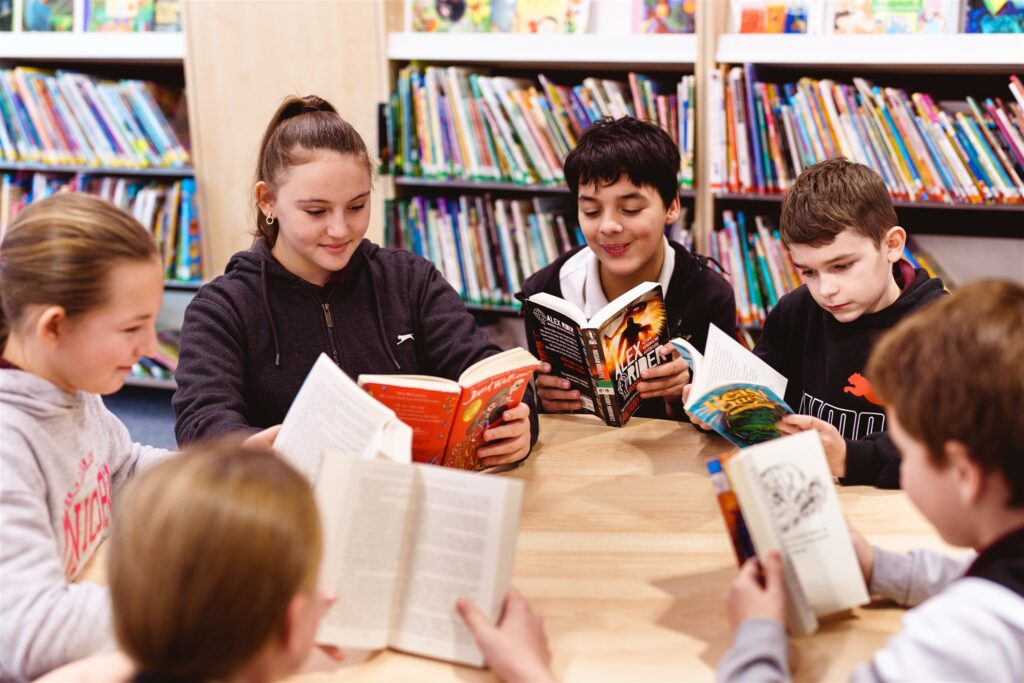
Author visits are always an exciting opportunity and prove very popular with pupils: hearing from a real-life writer provides children with the opportunity to ask questions about their writing journey, as well as being able to participate in the workshops which follow.
Family Reading Cafes provide the opportunity for us to welcome parents, carers and younger siblings into school to enjoy a story and complete an activity with their children in an informal environment.
Bi-weekly reading assemblies extend opportunities for reading for pleasure for all pupils.
Every March, we celebrate World Book Day and usually coincide this with a week-long visit from the Travelling Book Fair.
Reception and KS1 pupils can take home a bedtime book hamper (complete with a hot chocolate and cuddly toy!) to share a story with the parents / carers.
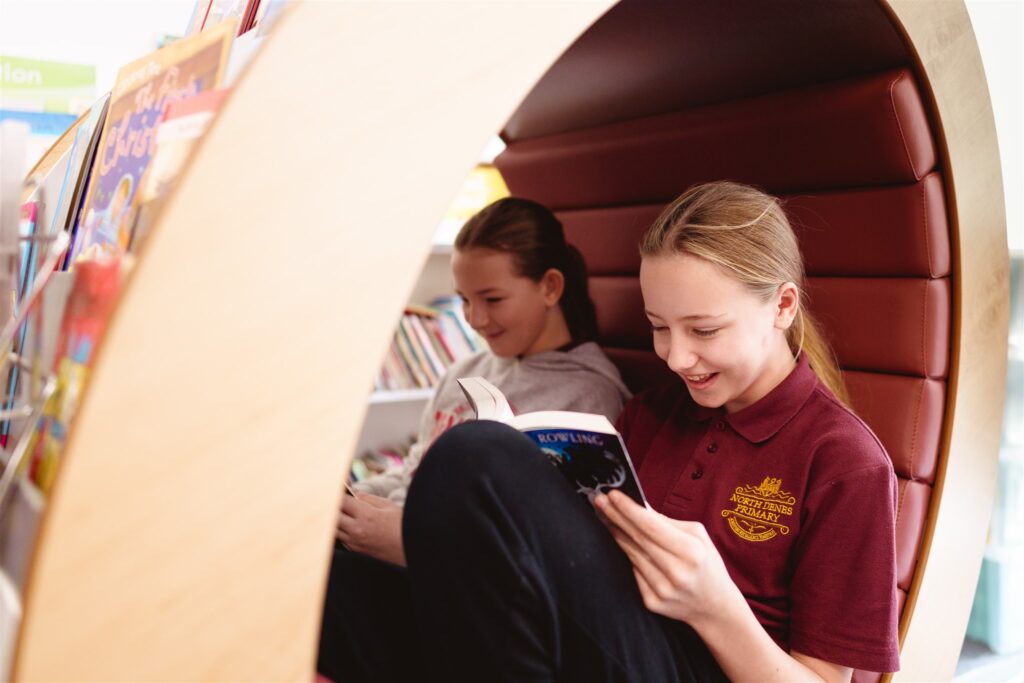
Teachers recommend a range of books for children to read on the ‘Bookflix’ board which is situated in the school library. Children can also recommend books to each other through a system of ‘book belts’.
The school has links with Great Yarmouth Library.
INTENDED IMPACT:
Children leave North Denes Primary School as happy, confident learners who have developed a love of reading and writing with the key skills and knowledge necessary for the next stage of their learning. They have high aspirations and are confident in the art of speaking and listening, able to successfully use discussion to communicate and further their learning.
Our pupils will leave North Denes Primary School:
In addition:
Quick Links
Home
Policies
Curriculum
Contact Us
Contact Us
North Denes Primary School
Jellicoe Road
Great Yarmouth
NR30 4HF
office@northdenes.norfolk.sch.uk
Tel . 01493 842063